
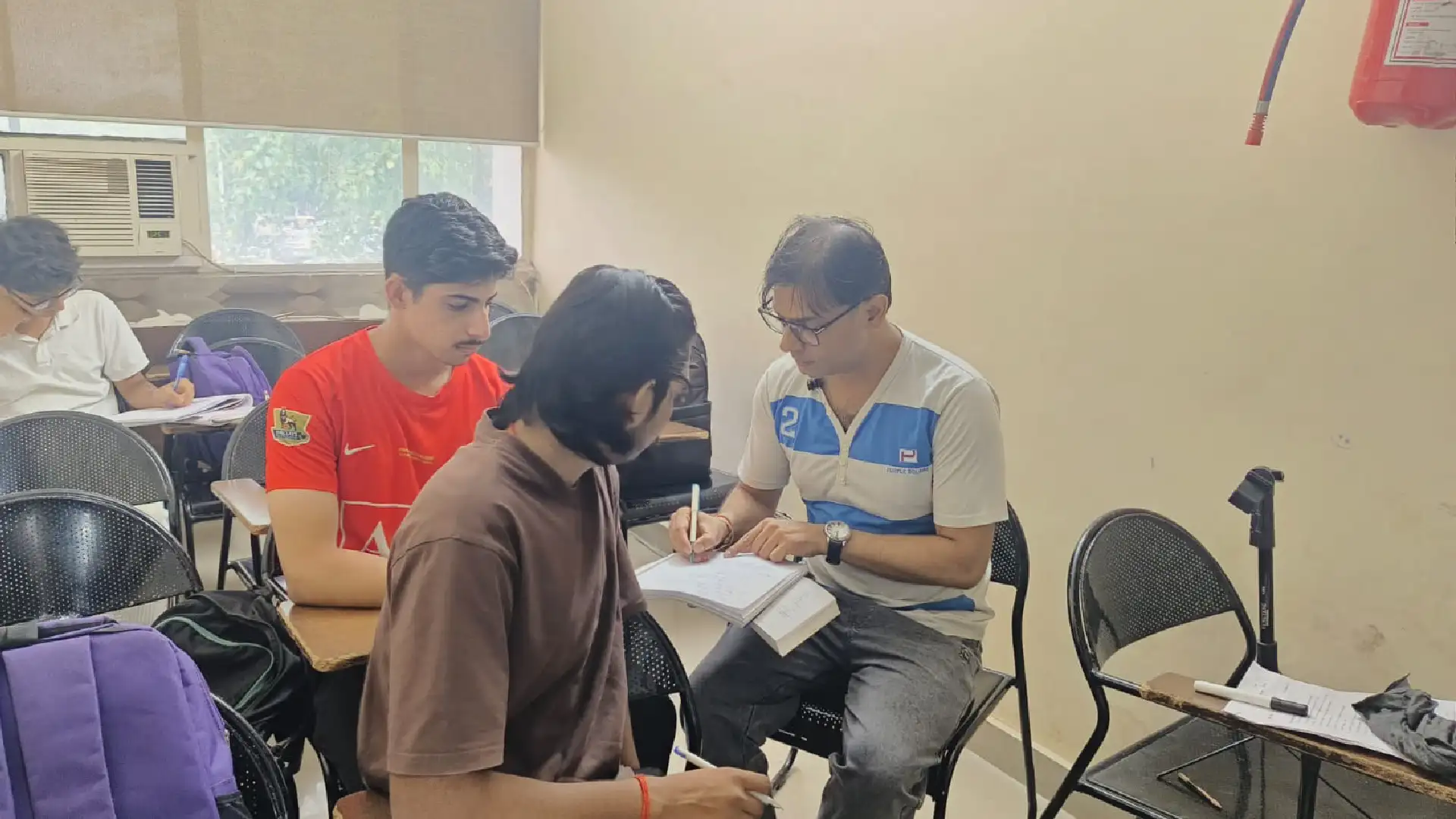
Scoring 90% plus in Physics Class 12 CBSE board exam is absolutely achievable but only with the right strategy, consistent daily effort, and a clear understanding of what the exam actually rewards. The key is not studying harder, it is studying smarter. Mastering high-weightage chapters, solving numericals every day, practising previous years’ papers, and taking regular mock tests are the four pillars that separate students who cross 90% plus from those who fall short by 10 to 15 marks.
At DISHA Teutonics+ Chandigarh and Kharar, Dheeraj Sir has helped hundreds of Class 12 students cross the 90% mark in Physics board exams year after year since 2003. This guide shares the exact strategy that works.
Most Class 12 students fear Physics, but very few realise that Physics is actually one of the most scoring subjects in the CBSE board exam if approached correctly. Unlike subjects that require extensive writing or subjective interpretation, Physics rewards students who understand concepts and can apply them accurately.
Every mark in the Class 12 Physics CBSE board paper comes from a predictable set of chapters, question types, and numerical patterns. Students who understand the exam structure and prepare accordingly consistently score higher than students who simply study the full textbook without a strategic focus.
The 70-mark theory paper follows a fixed pattern every year, and that predictability is your biggest advantage.
Before building a study plan, every student must understand exactly how the Class 12 Physics CBSE board exam is structured:
Understanding the pattern means you know exactly what to prepare — not everything equally, but the right chapters with the right depth.
Before building your Class 12 Physics preparation plan, it is important to understand the CBSE Physics 2026–27 unit-wise weightage. The 70-mark theory paper is divided across nine units, covering Electrostatics, Current Electricity, Magnetism, Electromagnetic Induction, Alternating Current, Electromagnetic Waves, Optics, Dual Nature, Atoms and Nuclei, and Electronic Devices.
| Unit | Chapters Covered | Marks |
|---|---|---|
| Unit I – Electrostatics | Chapter 1: Electric Charges and Fields; Chapter 2: Electrostatic Potential and Capacitance | 16 |
| Unit II – Current Electricity | Chapter 3: Current Electricity | Included in 16 |
| Unit III – Magnetic Effects of Current and Magnetism | Chapter 4: Moving Charges and Magnetism; Chapter 5: Magnetism and Matter | 17 |
| Unit IV – Electromagnetic Induction and Alternating Currents | Chapter 6: Electromagnetic Induction; Chapter 7: Alternating Current | Included in 17 |
| Unit V – Electromagnetic Waves | Chapter 8: Electromagnetic Waves | Included in 18 |
| Unit VI – Optics | Chapter 9: Ray Optics and Optical Instruments; Chapter 10: Wave Optics | Included in 18 |
| Unit VII – Dual Nature of Radiation and Matter | Chapter 11: Dual Nature of Radiation and Matter | Included in 12 |
| Unit VIII – Atoms and Nuclei | Chapter 12: Atoms; Chapter 13: Nuclei | Included in 12 |
| Unit IX – Electronic Devices | Chapter 14: Semiconductor Electronics: Materials, Devices and Simple Circuits | 7 |
| Total | Class XII Physics Theory | 70 |
Which Units Should You Prioritise?
Based on the CBSE Class XII Physics 2026–27 weightage, students should give particular attention to the following areas:
Key Insight
The 18-mark Optics + Electromagnetic Waves unit, 17-mark Magnetism + EMI/Alternating Current unit, and 16-mark Electrostatics + Current Electricity unit together account for 51 out of 70 theory marks. That is approximately 73% of the Class 12 Physics theory paper.
Therefore, students aiming for 90%+ in Physics should build strong conceptual understanding and practise numericals, derivations and previous-year questions from these high-weightage areas while also completing the remaining units systematically.
Follow this structured plan from the beginning of Class 12, not three months before boards:
Avoiding these mistakes is as important as following the right strategy:
Mistake 1: Skipping NCERT Examples
NCERT examples are directly asked in board exams, often word for word. Students who skip examples lose easy marks.
Mistake 2: Ignoring Derivations
Many students skip derivations hoping they will not appear. In CBSE Physics, derivations appear every year for 3 to 5 marks each. Skipping them is a guaranteed mark loss.
Mistake 3: Not Practising Numerical Steps
Board exams give step marks, even a wrong final answer scores partial marks if the method is correct. Students who rush and skip steps lose step marks unnecessarily.
Mistake 4: Leaving Electronic Devices for Last
Electronic Devices carries 7 marks and is considered easy, but students who leave it for the last week often run out of time. Cover it early.
Mistake 5: Studying Without a Schedule
Physics requires daily practice. Students who study in bursts, intensely for two days, then nothing for three, do not build the numerical fluency needed for 90%+.
Mistake 6: Using Only Reference Books
HC Verma and DC Pandey are excellent for JEE preparation, but for CBSE board exams, NCERT must be the primary source. Reference books should only supplement NCERT practice, not replace it.
At DISHA Teutonics+ Chandigarh and Kharar, the approach to Class 12 Physics board exam preparation is built around one goal, every student who puts in consistent effort should cross 90% plus.
Dheeraj Sir has been teaching Physics since 2003. His classroom approach covers:
For more information about the teaching approach and Physics coaching at DISHA Teutonics+, read our guide on Best Physics Tuition in Chandigarh for Class 11 and 12.
Small batch sizes at DISHA Teutonics+ mean Dheeraj Sir tracks every student individually, no student silently struggles with a concept while the class moves on.
For students also preparing for JEE and NEET alongside boards, the same conceptual depth used for board preparation directly supports JEE & NEET Physics preparation, making the dual track manageable without doubling the study hours.
Scoring 90% in Physics Class 12 CBSE board exam is not about talent, it is about consistency, strategy, and the right guidance. Students who start early, focus on high-weightage chapters, practise numericals every day, and take regular mock tests are the ones who consistently cross 90%, year after year.
If you are looking for expert Physics tuition in Chandigarh for Class 12 or structured Class 12 coaching at DISHA Teutonics+, visit us at SCO-97, Top Floor, Sector 40-C, Chandigarh or SCF-4, Ground Floor, Sector 125, Sunny Enclave, Kharar. Attend a 1 Day FREE Demo Class and experience the teaching approach firsthand before enrolling. Call 9872035343 to book your demo today.
Q1. Is it possible to score 90% in Physics Class 12 CBSE?
Yes, scoring 90% in Physics Class 12 CBSE is absolutely achievable with the right study plan, consistent numerical practice, and strong concept clarity. Optics and Electrostatics alone contribute 34 marks, mastering these two units puts 90% well within reach.
Q2. Which chapters are most important for the Class 12 Physics CBSE board exam?
The most important chapters for Class 12 Physics CBSE are Optics (18 marks), Magnetic Effects and EMI (17 marks), and Electrostatics with Current Electricity (16 marks). These three units together account for over 70% of the total paper weightage.
Q3. How many hours should I study Physics for Class 12 boards?
Class 12 Physics requires a minimum of 1.5 to 2 hours of dedicated daily study, split between concept revision, numerical practice, and derivation writing. Consistency every day matters far more than long study sessions once a week.
Q4. Should I study NCERT or reference books for Class 12 Physics boards?
NCERT is mandatory for Class 12 Physics CBSE board exams. Every board question traces back to NCERT concepts. Reference books like HC Verma should only be used for additional numerical practice, after NCERT is fully covered.
Q5. How can coaching help me score 90% in Class 12 Physics?
Expert Physics coaching in Chandigarh for Class 12 helps students identify high-weightage chapters, practise exam-pattern numericals, clear conceptual doubts immediately, and take regular mock tests, all essential for crossing 90% in CBSE boards.
“At Disha Teutonics+, we guide students with proven strategies and personal mentorship to help them achieve academic excellence and succeed in competitive exams.”
Copyright ©2026 Dishtek Teutonics+. All rights reserved. Design & Developed By: Dhruvdeep Singh